Co-Precipitation Method: The Core Technology Behind Cathode Material Manufacturing
Related Topics
Discover how the co-precipitation method drives cathode material manufacturing for lithium-ion batteries. Learn about process steps, advantages, and why it's the industry standard.
Follow us on
Battery makers face a constant challenge: how to create cathode materials that deliver high performance while keeping costs under control. We've found that the co-precipitation method has become the go-to solution for manufacturing battery cathode precursors, especially for the nickel-manganese-cobalt (NMC) and nickel-cobalt-aluminum (NCA) chemistries powering today's electric vehicles. This technique lets us produce uniform, high-quality precursor materials at scale—something that's tough to achieve with other synthesis routes.
At Highstar, we understand that the quality of active material directly determines battery performance. That's why understanding co-precipitation is so valuable for anyone working in energy storage.
What Makes Co-Precipitation the Industry Standard
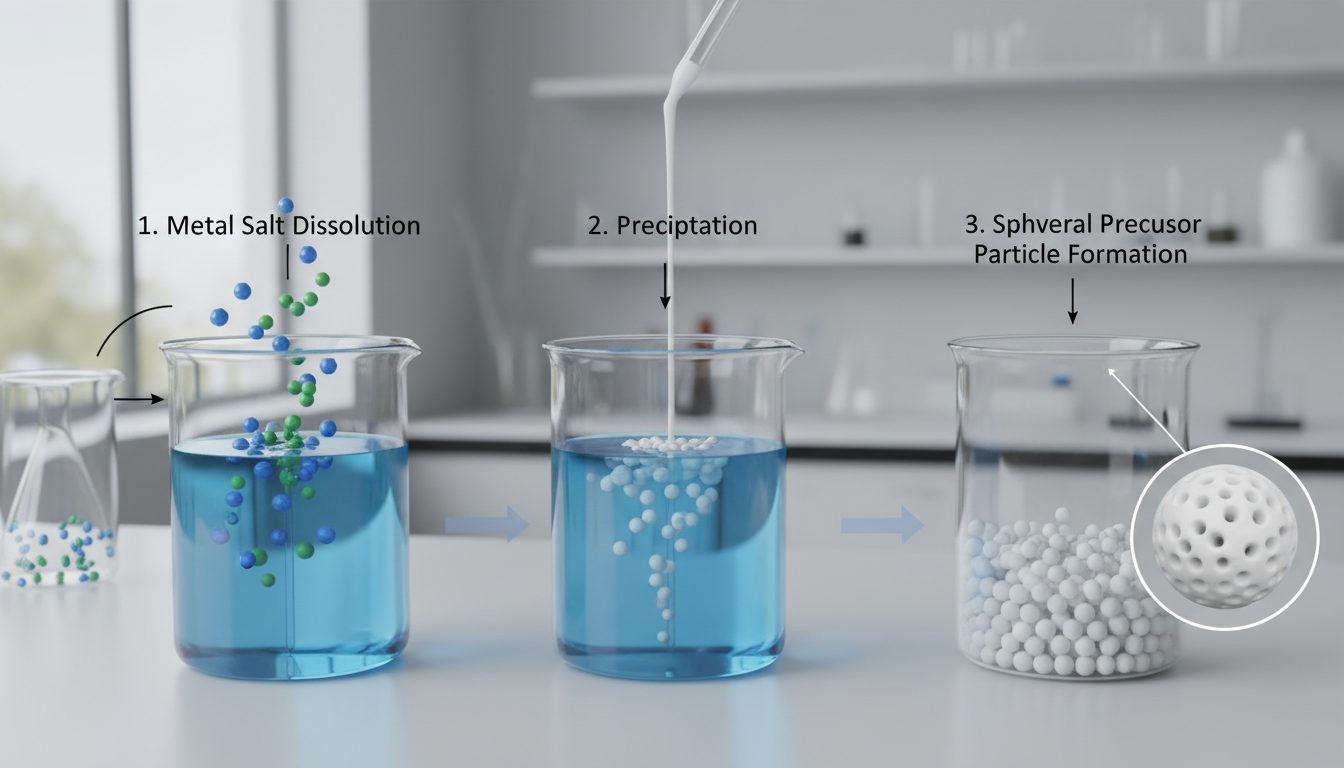
Co-precipitation is a process where multiple metal ions precipitate simultaneously from a solution to form a uniform precursor material. Think of it like making rock candy—but instead of sugar crystals, we're creating precisely engineered metal hydroxide or carbonate particles.
The process starts by dissolving transition metal salts (nickel, cobalt, and manganese sulfates) in water at specific concentrations. When we add a precipitating agent like sodium hydroxide or ammonium hydroxide while controlling pH and temperature, these metals form solid particles together. The beauty is that all the metals precipitate at the same time, creating particles where nickel, cobalt, and manganese are evenly distributed at the atomic level.
This simultaneous precipitation matters because it produces precursors with homogeneous composition throughout each particle. That uniformity translates directly to better battery performance down the line.
How the Co-Precipitation Process Actually Works
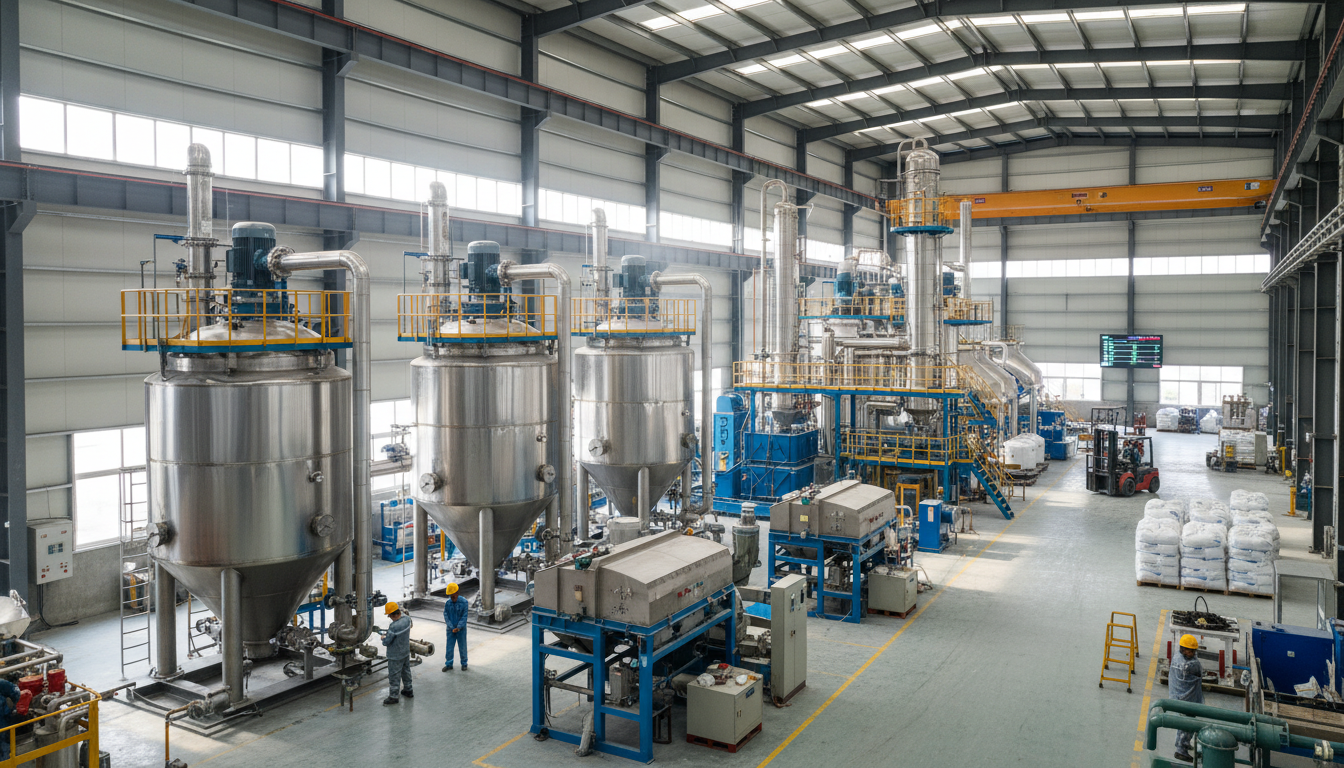
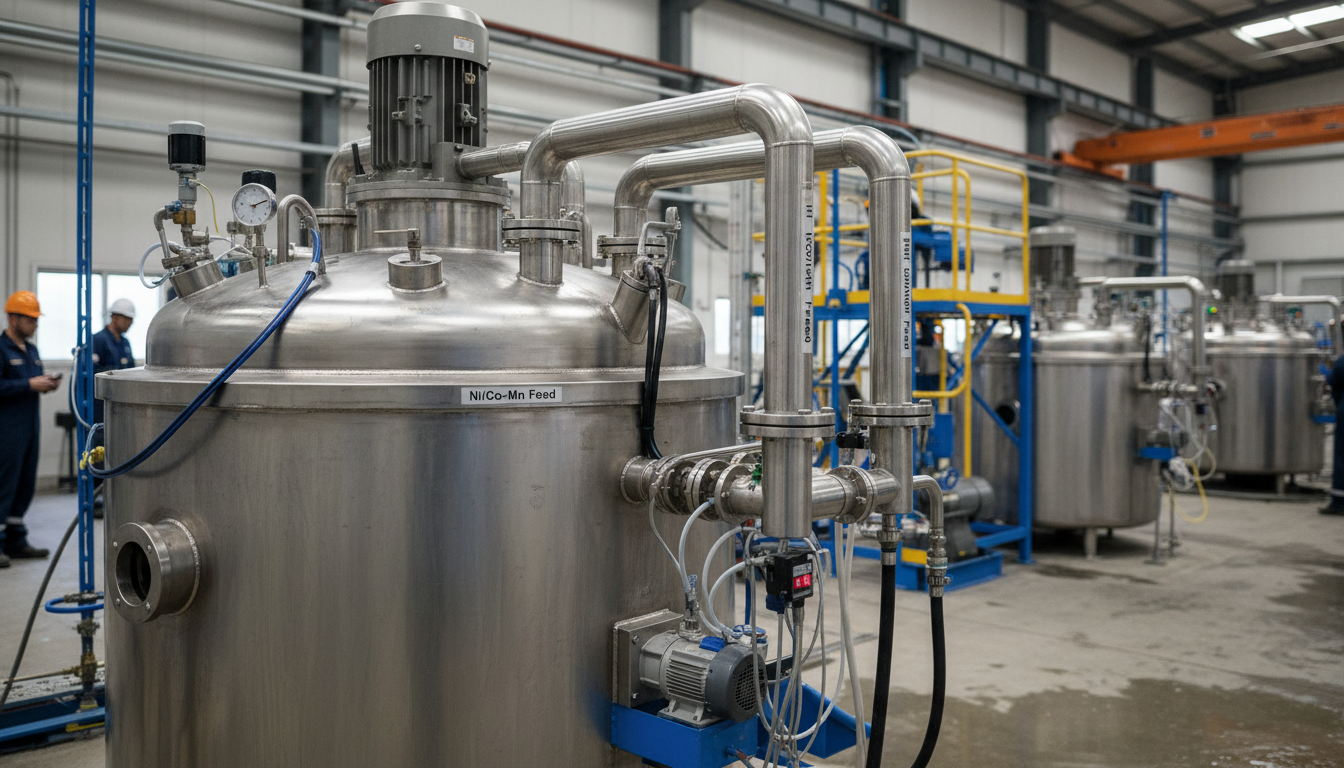
The co-precipitation process for cathode precursors happens in specialized continuous stirred-tank reactors (CSTR). These reactors typically hold 20-6500 liters and maintain precise control over multiple variables.
Here's how we do it: Metal salt solutions flow into the reactor along with alkali solution and often ammonia (which acts as a chelating agent). The pH stays tightly controlled—usually between 8.0 and 12.0—while temperature holds steady around 50-60°C. Stirring speed matters too, affecting particle size and morphology.
Ammonia plays a dual role. It complexes with the metal ions, controlling the precipitation rate and helping form those desirable spherical secondary particles made of smaller primary particles. But ammonia use comes with downsides—higher costs and environmental concerns from waste treatment.
After precipitation, the slurry moves to an aging tank where particles continue developing their structure. Then comes washing (usually with dilute alkali and hot water), filtering, and drying at around 130°C. The result? A precursor powder ready for lithiation, where we'll mix it with lithium carbonate or lithium hydroxide and heat it to 700-900°C to create the final cathode material.
Types of Co-Precipitation: Hydroxide vs. Carbonate
We mainly see three co-precipitation variants in commercial production: hydroxide, carbonate, and oxalate methods. Each has its place.
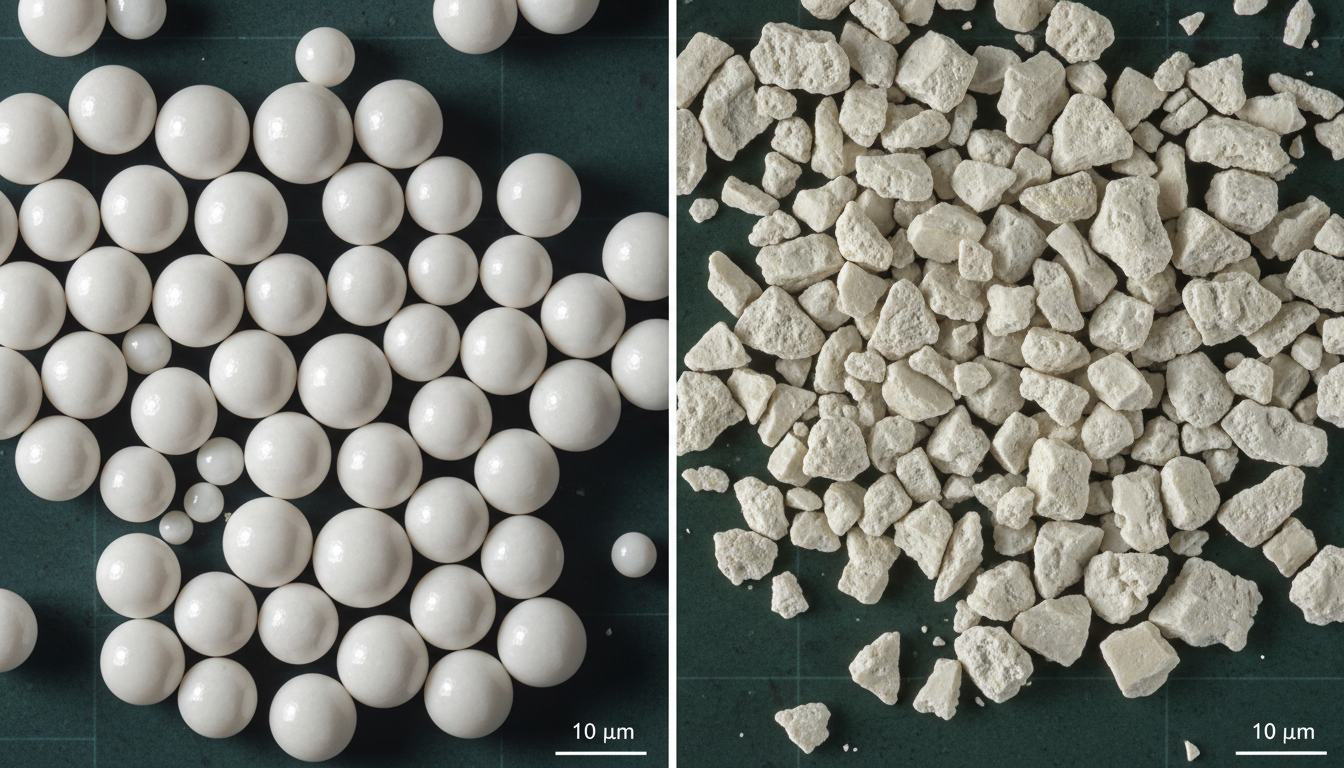
Hydroxide co-precipitation dominates the industry for NMC cathodes. It creates NixMnyCo1-x-y(OH)2 precursors and offers the best control over particle morphology. The process is reliable and produces high-quality spherical particles with tap densities around 2.0-2.4 g/mL.
Carbonate co-precipitation uses sodium carbonate as the precipitating agent instead of hydroxide. This route prevents oxidation of Mn²⁺ to Mn³⁺ during synthesis, keeping all transition metals in the +2 oxidation state. That's particularly useful for manganese-rich compositions.
Oxalate co-precipitation is newer and offers some advantages—faster precipitation (sometimes just 10 minutes versus hours), lower temperatures, and the ability to skip the ammonia. Recent studies show oxalate precursors can achieve similar or better electrochemical performance compared to hydroxide routes.
Why Co-Precipitation Beats Other Synthesis Methods
So why pick co-precipitation over alternatives like solid-state mixing or sol-gel? The reasons stack up quickly.
First, composition control is unmatched. Because metals precipitate together, the final precursor has the exact stoichiometry we designed. Solid-state methods struggle with this—mixing metal oxides as powders never achieves the same atomic-level homogeneity.
Second, scalability is straightforward. Continuous co-precipitation in large reactors produces consistent material properties—particle size, morphology, tap density—throughout hours or days of operation. That consistency matters when you're making tons of material monthly.
Third, particle engineering is possible. By adjusting pH, stirring, temperature, and chelating agents, we can tune particle size from a few microns to over 20 microns and control morphology from irregular to perfectly spherical. Our ternary lithium products benefit from this precise control.
The economic case is solid too. While co-precipitation needs more equipment than simple solid-state synthesis, the material quality and yield justify the investment. Studies comparing co-precipitation to flame spray pyrolysis found co-precipitation costs remain competitive, especially for proven chemistries.
Recent Advances: Making Co-Precipitation Cleaner and Faster
The industry isn't standing still. New developments are addressing co-precipitation's traditional pain points.
Ammonia-free processes have emerged from research labs. Oak Ridge National Laboratory developed a hydrothermal co-precipitation route that eliminates ammonia entirely while improving tap density and reducing water consumption. This addresses both cost and environmental concerns.
Taylor-Couette flow reactors use rotating cylinders to create unique flow patterns that produce more uniform particles with less structural distortion. Materials made this way show better capacity retention—over 97% after 100 cycles.
Slug flow coprecipitation represents another innovation. This technique uses millimeter-scale fluidic channels where reactants mix in discrete slugs. The whole precipitation takes 10 minutes instead of hours, produces incredibly uniform particles, and doesn't need the aging step.
These advances show how we're making the core co-precipitation technology more efficient, environmentally friendly, and cost-effective.
Key Process Parameters That Determine Quality
Getting co-precipitation right means controlling multiple variables precisely. Small changes can dramatically affect the final product.
pH control might be the most critical parameter. At pH below 10, nickel precipitates more slowly than cobalt and manganese, creating composition gradients. Above pH 12, rapid precipitation can trap impurities. The sweet spot depends on the specific composition but typically falls between 10.5-11.5 for nickel-rich cathodes.
Temperature affects precipitation rate and particle growth. Higher temperatures (50-60°C) speed up reactions and help form larger, denser particles. But go too hot and you risk unwanted side reactions or irregular morphologies.
Stirring speed influences particle size distribution and prevents agglomeration. Too slow and particles settle unevenly; too fast and you get smaller, less dense particles. Most industrial processes use 200-400 rpm depending on reactor size.
Residence time in the reactor determines particle size. Longer residence (8-12 hours) allows particles to grow larger and develop the spherical secondary structure we want. Continuous production means controlling flow rates to maintain steady-state conditions.
Ammonia concentration affects how metal complexes form and precipitate. Higher ammonia creates more stable complexes, slowing precipitation and allowing better particle formation. But excess ammonia means more waste treatment later.
Conclusion
The co-precipitation method remains the backbone of cathode precursor manufacturing because it delivers what battery makers need: homogeneous composition, controlled morphology, and industrial scalability. While challenges like ammonia use and water consumption persist, recent innovations are making the process cleaner and more efficient.
For companies producing lithium-ion cells or advanced battery systems, understanding co-precipitation helps optimize material selection and processing. As battery chemistries evolve toward higher nickel content and new form factors, co-precipitation will continue adapting, proving its value as a versatile manufacturing platform for next-generation energy storage.
FAQs
What is the co-precipitation method in battery manufacturing?
Co-precipitation is a synthesis technique where multiple transition metal ions (nickel, cobalt, manganese) simultaneously precipitate from a solution to form a uniform precursor powder. This precursor is then mixed with lithium and heated to create the final cathode material. The method produces particles with homogeneous composition at the atomic level, which improves battery performance compared to simple mixing methods.
Why is co-precipitation preferred over solid-state synthesis for NMC cathodes?
Co-precipitation creates atomic-level mixing of metals that solid-state methods can't match. When you just mix metal oxide powders and heat them, you get composition variations between particles and even within particles. Co-precipitation forms each particle with all metals evenly distributed from the start. This uniformity leads to better capacity, longer cycle life, and more consistent performance. The method also allows better control over particle size and shape.
What are the main challenges with the co-precipitation process?
The biggest challenges include ammonia use (which adds cost and creates environmental waste), high water consumption for washing steps, and the need for precise control over multiple parameters simultaneously. pH fluctuations, temperature variations, or inconsistent stirring can create quality issues. Newer ammonia-free routes and continuous monitoring systems are addressing these problems, but they require more sophisticated equipment and process knowledge.
How long does the co-precipitation process take?
Traditional co-precipitation in continuous stirred-tank reactors runs with residence times of 8-12 hours, followed by several hours of aging. After that comes washing, filtering, and drying—adding another 6-12 hours. Total time from solution to dried precursor powder typically runs 24-36 hours. Newer techniques like slug flow coprecipitation have reduced precipitation time to just 10 minutes, though they're not yet widely adopted in large-scale production.
Can co-precipitation be used for all cathode chemistries?
Co-precipitation works well for layered oxide cathodes like NMC, NCA, and high-nickel variants. It's also used for spinel materials like LNMO. But it's not suitable for all cathode types—lithium iron phosphate (LFP) typically uses different synthesis routes like hydrothermal or solid-state methods. The technique works best when you need to combine multiple transition metals with precise control over composition and morphology.
Highstar attaches great importance to your personal privacy. When you visit our website, please agree to the use of all cookies. More information about the processing of personal data can be found at "Privacy Policy"


 Buy
Buy